Pythagoras and the Sacred Decad
The historical Pythagoras (c. 570–495 BCE) is not the cartoon mathematician of school textbooks. He was the founder of a religious order whose initiates lived communally, observed dietary discipline, kept silence for years, and held that number is the underlying substance of reality. The Pythagoreans discovered that musical harmony depends on whole-number ratios (2:1 octave, 3:2 fifth, 4:3 fourth) and concluded — not unreasonably — that if sound is governed by numerical ratio, perhaps everything is.
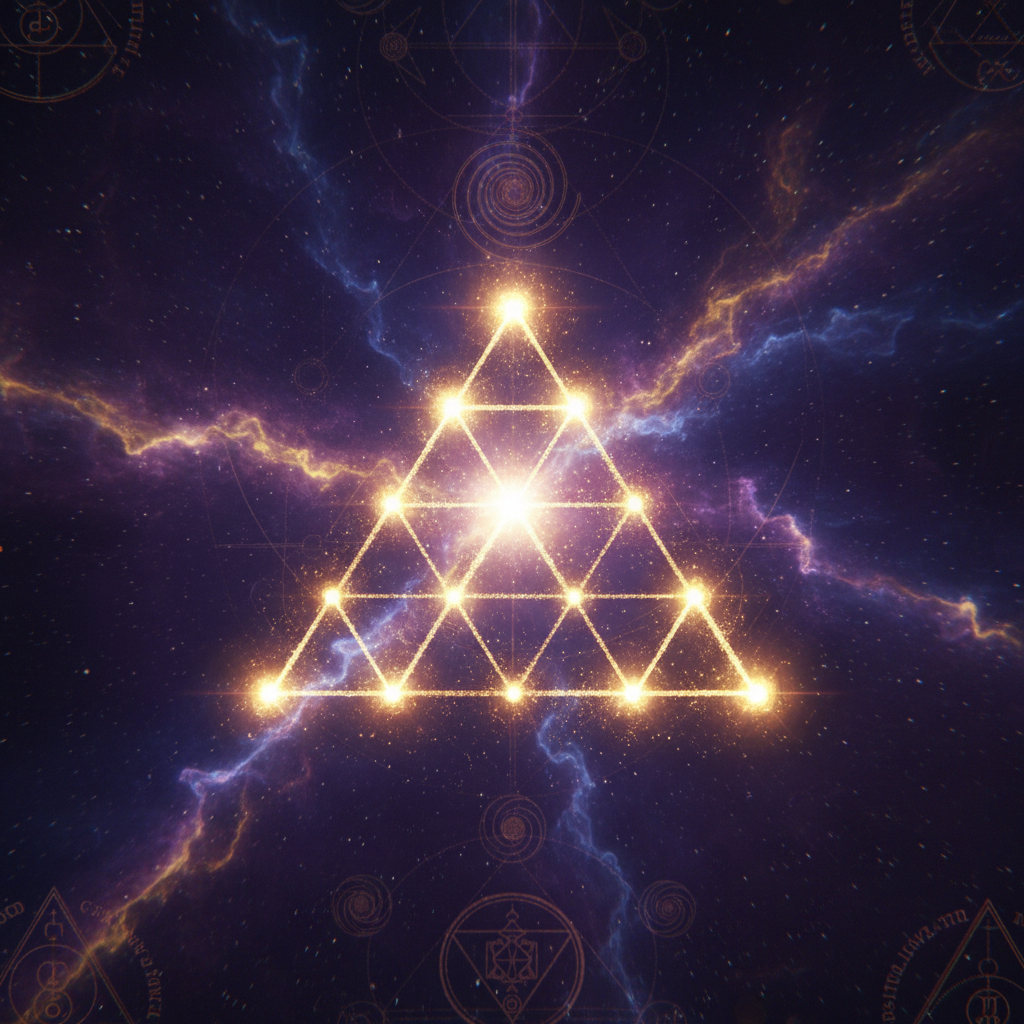
The central object of Pythagorean meditation was the tetractys: a triangular figure of ten dots arranged in four rows (1, 2, 3, 4). Initiates swore oaths upon it. The tetractys encodes:
• The first four integers, summing to 10 (the perfect number).
• The geometric generation of the cosmos: 1 (point) → 2 (line) → 3 (plane) → 4 (solid).
• The intervals of the musical scale.
• The ten archetypal forces of which everything else is a derivation.
Western numerology — the system that assigns numerical values to letters and reduces numbers to single digits — descends in a continuous tradition from Pythagorean number-mysticism, through the Neoplatonists, through the Renaissance Hermeticists (Cornelius Agrippa, *De Occulta Philosophia*, 1533), into modern practice. Whether one considers it scientifically valid or not, it is a coherent two-and-a-half-millennium intellectual lineage of considerable sophistication.
Gematria — When the Letters Are the Numbers
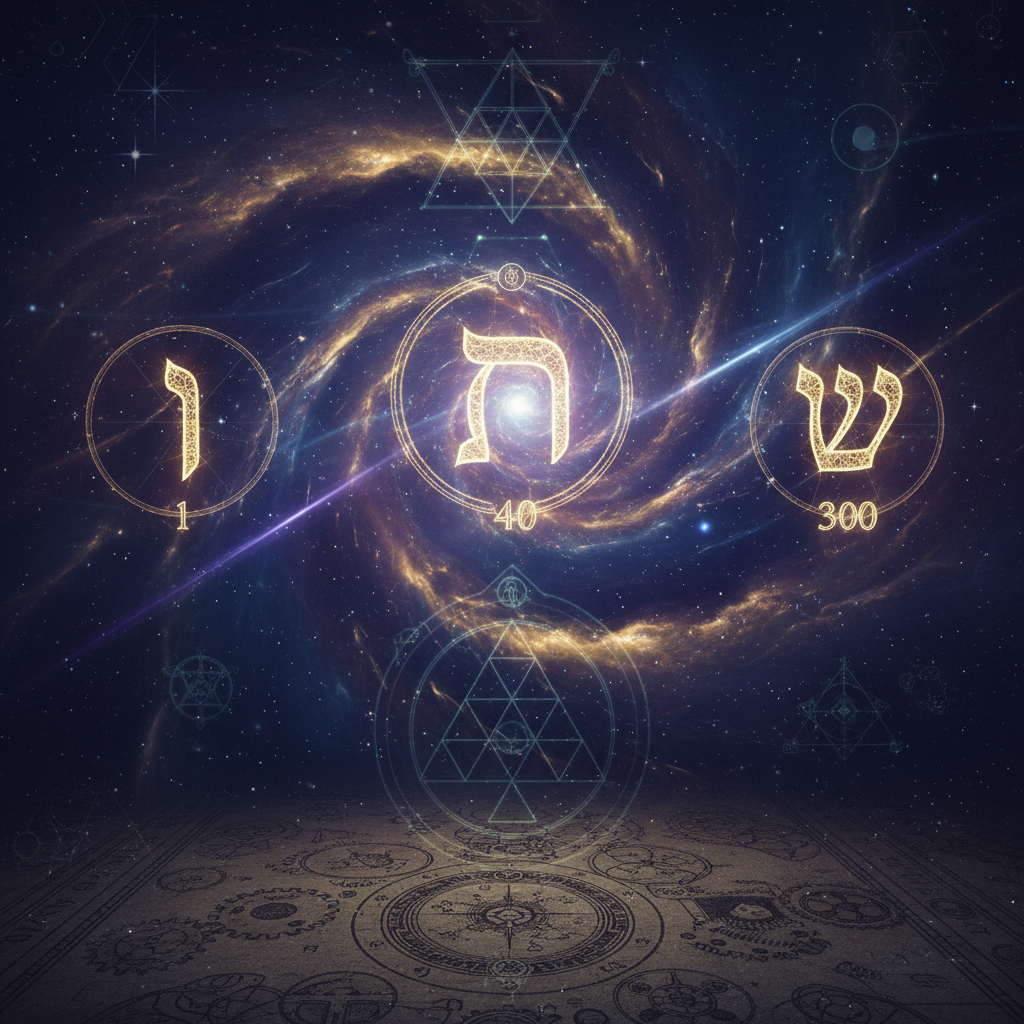
Hebrew, Greek and Arabic alphabets all share a structural feature that English does not: the letters themselves are numbers. Aleph = 1, Beth = 2, Gimel = 3 ... Yod = 10, Kaph = 20, and so on. Every word therefore has a numerical value — its gematria — equal to the sum of its letters.
This property turns text into a multi-layered cipher. In Jewish mystical tradition, beginning at least as early as the Sefer Yetzirah (c. 200 CE) and reaching its full development in the 13th-century Zoharic Kabbalah, words with the same gematria are held to share an essential resonance — not as coincidence but as a structural feature of the divine creative speech that brought reality into being.
Famous examples:
• *Ahavah* (love, אהבה) and *Echad* (one, אחד) both equal 13 — love is the operation of unity.
• The Tetragrammaton (יהוה, the four-letter divine Name) equals 26; the gematria of *Adonai* (אדני, Lord) equals 65; together (the substituted reading) they sum to 91, the same value as *Amen* (אמן).
• In Christian Greek gematria, *Iesous* (Jesus, Ιησους) equals 888 — the inverse and antitype of 666.
Greek isopsephia, Arabic abjad and the somewhat later European ars notoria all developed parallel systems. The historical evidence is unambiguous that significant theological and philosophical content was deliberately encoded in the numerical structure of ancient texts; the question of whether reading it back out yields operative meaning, or only ingenious post-hoc pattern-matching, is the live debate.
The 11:11 Phenomenon
Over the last two decades, an unprecedented cross-cultural phenomenon has emerged: very large numbers of people independently report repeatedly noticing the time 11:11 (and adjacent repeating sequences — 1:11, 2:22, 3:33, etc.) on clocks, receipts, license plates and timestamps, often during periods of personal transition.
The skeptical explanation is straightforward and largely correct as far as it goes: frequency illusion (the Baader–Meinhof effect). Once the brain is primed to a pattern, it preferentially registers occurrences of that pattern from the constant background of incidental data. The clock shows 11:11 only twice a day; we look at the clock dozens of times daily; over time, the hits accumulate while the misses are forgotten.
This is unquestionably part of the phenomenon. It is also probably not the whole story.
What the frequency-illusion explanation does not account for is the emotional valence consistently reported — a felt sense of synchronistic significance, often clustering around objectively documented life-transition periods, often accompanied by other reported coincidences in compressed time. The Jungian framework discussed in *Synchronicity & the Collective Unconscious* applies cleanly: the 11:11 phenomenon may be a contemporary mass occurrence of archetypal-field activation, with the digital clock serving as the ubiquitous random-event generator that the modern environment has provided in unprecedented abundance.
The operative recommendation from the older numerological traditions is simply: when the pattern intrudes on attention, briefly interrupt the activity, draw breath, and silently ask what wants to be noticed. Treat it as an alarm clock from the unconscious. Do not over-interpret. Do not dismiss. Note in a journal across six months and see what pattern emerges from the patterns.
A Skeptical Practitioner's Use of Numerology
The Pythagorean reduction system — the basis of most modern Western numerology — works as follows: each letter is assigned a value (A=1, B=2 ... I=9, J=1, K=2 ...). The letters of a name or word are summed and the sum reduced by addition of digits to a single digit (with the exception of master numbers 11, 22, 33, which remain unreduced). The resulting number is interpreted according to a traditional symbolic key.
Whether one believes the resulting numbers carry literal occult significance, the diagnostic exercise of computing the numerology of one's own name and birth date and reading the traditional interpretation has consistent value as a Rorschach: it generates a structured framework against which the practitioner notes what resonates, what does not, and (crucially) what they had not previously articulated about themselves but now find described.
This is exactly how the wisest practitioners of numerology — and tarot, and astrology — describe the practice. The system is a mirror. It draws articulation out of the user, not (or not only) information into the user. Whether the underlying number is in any literal sense a real attribute of the universe is a metaphysical question on which honest people disagree. That working through the system reliably surfaces useful self-knowledge is an empirical observation that can be tested in an evening.
Keep the calculation. Read the traditional interpretations. Note honestly what lands. Repeat for the names of significant others, your home address, your business. The data set you generate from a few weeks of this is more valuable than any general-purpose verdict on whether numerology "works."