Cymatics — Sound Made Visible
In 1787, the German physicist Ernst Chladni placed sand on a metal plate and drew a violin bow across its edge. The sand, agitated by the plate's resonant vibration, organised itself into precise geometric patterns — stars, hexagons, intricate lattices. Different frequencies produced different patterns. The same frequency always produced the same pattern.
Chladni had discovered the visible architecture of sound. The Swiss physician and naturalist Hans Jenny (1904–1972) extended the work into what he named cymatics (Greek *kyma*, wave). Using piezoelectric drivers and high-speed cinematography, Jenny documented frequencies producing not only static patterns but living, flowing structures in liquids, pastes, and powders — structures that resembled cell division, planetary surfaces, mandalas, and the floor plans of medieval cathedrals.
The central, replicable observation of cymatics is this: vibration organises matter into geometric form, and the geometry is determined precisely by the frequency. Every sustained tone in the universe corresponds to a specific spatial pattern. The implication, which the ancient mystery schools insisted on, is that geometric form is frozen frequency — and frequency, in turn, is the fundamental currency of reality.
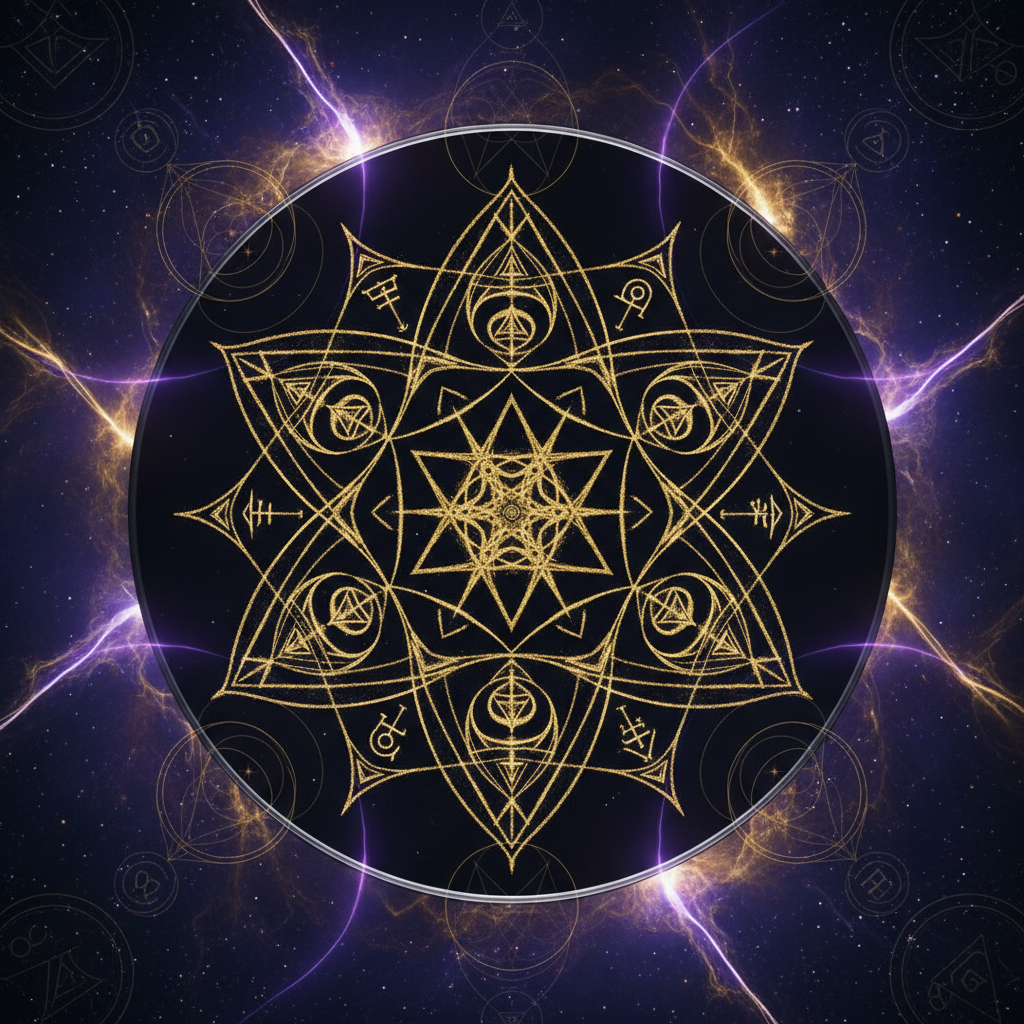
The Universal Patterns
When ancient civilisations across Egypt, India, China, Mesoamerica, Greece and the Islamic world independently encoded the same handful of geometric figures into their sacred architecture, art and ritual, they were not imitating one another. They were observing the same underlying reality.
The Flower of Life. Found etched into the granite pillars of the Osirion at Abydos, in synagogues at Galilee, in Buddhist temples in Tibet, and in Leonardo's notebooks. Nineteen interlocking circles producing every Platonic solid as a derivation. The geometric template from which the periodic table itself can be reconstructed.
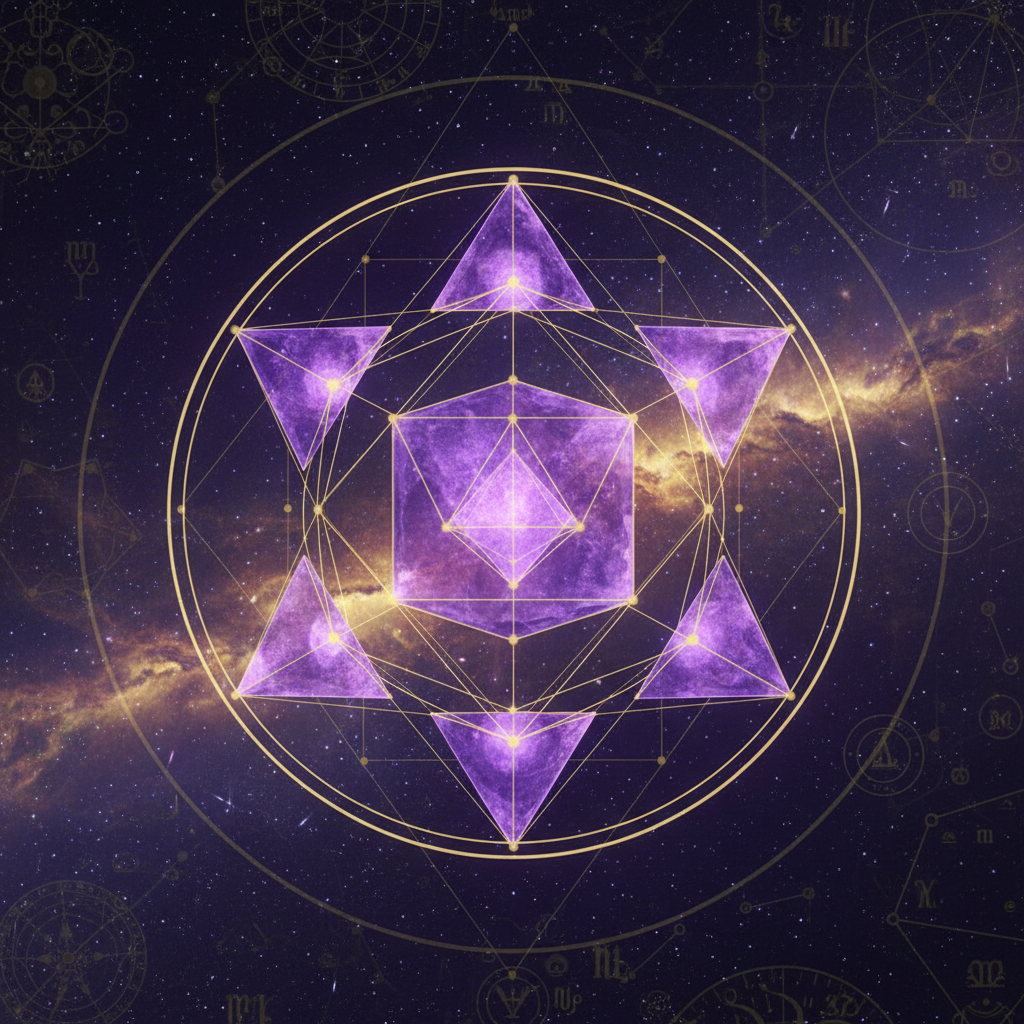
Metatron's Cube. Generated from the Flower of Life by connecting the centres of all thirteen central circles. Contains, projected within it, all five Platonic solids — the only convex polyhedra in which every face, edge and angle is identical. Plato in the *Timaeus* identified them with the elements.
The Sri Yantra. Nine interlocking triangles forming forty-three smaller triangles around a central point. Reproduced precisely in cymatic experiments at the OM frequency (~136.1 Hz). Whether the ancient Tantric mathematicians who designed it had access to driven plates and high-speed photography is a question worth asking.
The Golden Ratio (φ ≈ 1.618). The proportional relationship found in the spiral of nautilus shells, the arrangement of sunflower seeds, the proportions of the human body, the Parthenon, the Great Pyramid, and the geometric scaffolding of the Sri Yantra. The ratio at which growth stops being mere repetition and becomes form.
Why It Works on the Brain
Modern neuroaesthetic research (Ramachandran, Zeki, Hekkert) has documented that the human visual cortex shows preferential, measurable response to certain proportions, symmetries and fractal patterns. Functional MRI studies show increased activation in the medial orbitofrontal cortex — the brain's reward-relevance region — when subjects view forms exhibiting golden-ratio proportions or six-fold radial symmetry, even when subjects cannot consciously identify why the forms are pleasing.
This is not aesthetic preference. It is resonance. The visual cortex, the auditory cortex and the body's connective tissue all respond to certain frequency relationships in measurably consistent ways across the species. The ancient mystery schools encoded these relationships into temple architecture, mandala practice, chant and dance because doing so reliably produced specific cognitive and emotional states in the practitioner.
A Gothic cathedral built to golden-ratio proportions, filled with chant tuned to specific intervals, viewed through coloured light at a precise time of day, is — from a neuroaesthetic standpoint — a frequency-engineering machine. The mediaeval masons knew exactly what they were doing. The records survive in lodge documents from Strasbourg, Reims and Cologne; the documents are simply written in a vocabulary modern science had to relearn from scratch.
Working with Sacred Geometry Yourself
The traditional use of sacred geometry — across Sufi *naqshbandi* meditation, Vajrayana mandala practice, Hermetic visualisation and Pythagorean contemplation — is gazing. The form is held at a distance of arm's length, eyes soft, and the practitioner permits the geometry to organise consciousness rather than analysing it.
The well-documented effects after 15–25 minutes include theta-wave brain activity comparable to advanced meditators, parasympathetic dominance, and access to insight states often described as recognition rather than discovery — as though the geometry were activating something already present.
Practical protocol:
1. Choose one figure — Sri Yantra, Flower of Life, or a single Platonic solid.
2. Sit upright, the figure 50–70 cm from your eyes at eye level.
3. Soften the gaze. Do not analyse. Permit the eye to drift, the figure to subtly pulse, the visual field to begin to dissolve.
4. Continue for 15–20 minutes daily. Do not skip. Do not multiply.
Within 3–4 weeks, most practitioners report changes in dream content, heightened pattern recognition in waking life, and a quiet but unmistakable shift in the texture of attention itself. Reports remarkably consistent with what the ancient texts describe — and what cymatics suggests is structurally inevitable when a coherent geometric pattern is impressed sustainedly upon a resonant system.