The Golden Scarab
In Carl Jung's consulting room in Zurich, a particularly rationalistic patient was recounting a dream from the previous night: someone had given her a piece of expensive jewellery — a golden scarab. As she spoke, Jung heard a tapping behind him. He turned, opened the window, and caught in his hand the only beetle native to that region that resembles a scarab: a rose-chafer (Cetonia aurata), shimmering gold-green. He handed it to his patient with the words: *"Here is your scarab."*
In ancient Egypt, the scarab was the symbol of rebirth. Jung's patient — psychologically locked behind the iron defences of pure rationalism — broke open. Her treatment, previously stalled, advanced rapidly.
Jung called such events synchronicity: meaningful coincidences in which inner psychic states and outer physical events correspond in a way that defies ordinary cause and effect. He developed the concept over four decades, in close dialogue with quantum physicist Wolfgang Pauli, and published the definitive essay *Synchronicity: An Acausal Connecting Principle* in 1952.
The Collective Unconscious
Jung's deeper claim — and the one that makes synchronicity comprehensible — is that the human psyche is structured at its base by the collective unconscious: a layer of mind shared by all humans, populated by primordial patterns Jung called archetypes.
Archetypes are not images but tendencies to form images — universal templates around which experience crystallises. The Mother. The Wise Old Man. The Trickster. The Self. The Shadow. They appear in every mythology, every religion, every culture's dreams, because they are not learned but inherited as part of being human.
From this perspective, synchronicity is not a violation of physics. It is a glimpse of the underlying unity from which both psyche and matter emerge. When an archetype is constellated — activated within a person at a moment of inner crisis or transformation — events in the surrounding world are statistically more likely to mirror it. Not because the inner state caused the outer event, but because both arise from the same deeper pattern.
Pauli, who shared the 1945 Nobel Prize in Physics, found this idea so compelling that he and Jung jointly proposed the *unus mundus* — "one world" — where psyche and matter are two aspects of a single underlying reality. The mathematics of quantum entanglement, in which separated particles instantly share state, struck both men as the physical analogue of synchronicity.
The I Ching and the Acausal
Jung wrote the introduction to the Wilhelm-Baynes translation of the I Ching (1949) and used the oracle himself for forty years. His justification was philosophically precise: where Western science asks *what causes what*, Chinese divinatory thought asks *what is meaningfully present together at this moment*.
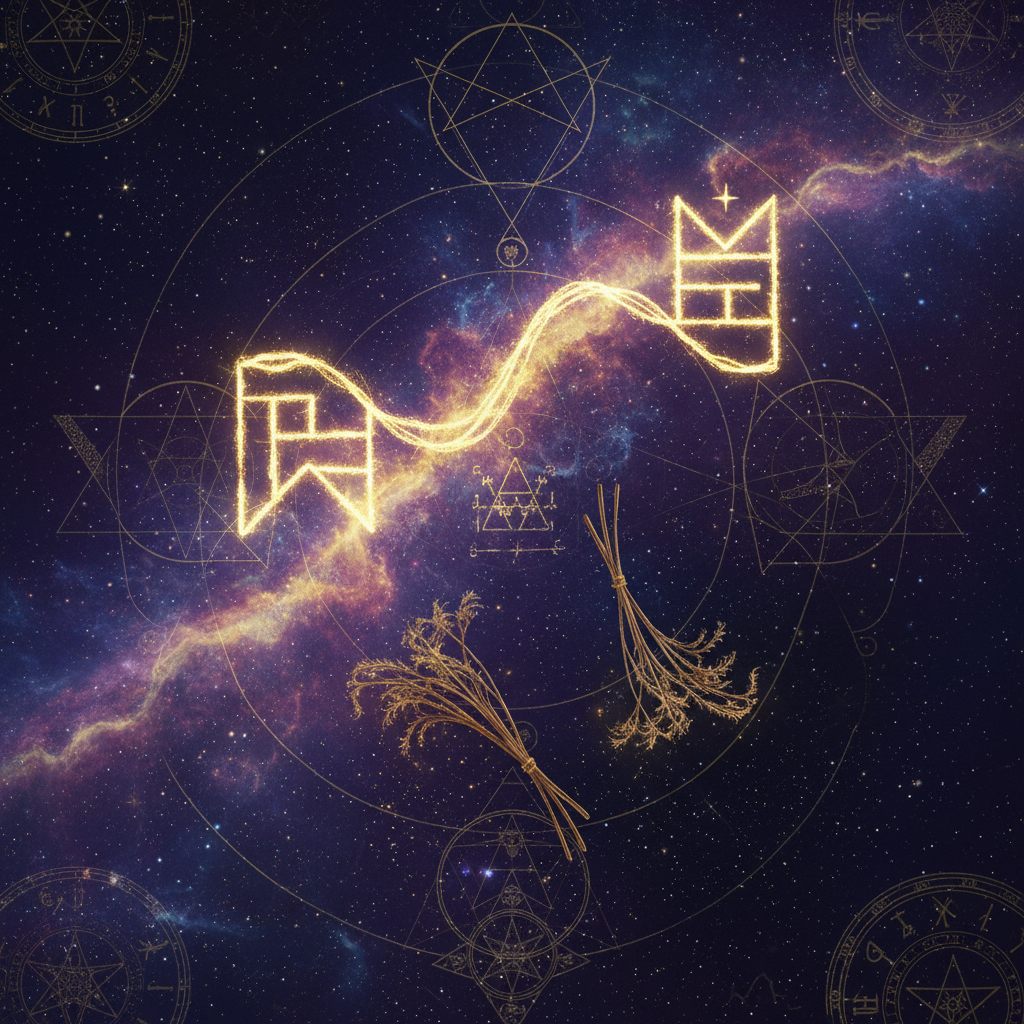
The I Ching method — yarrow stalks or coins producing a hexagram — is, statistically, random. But Jung argued (and tested experimentally) that the hexagram produced at the moment of asking is not unrelated to the question. The same psychic field that prompts the question shapes the apparent randomness. In modern terms: the consultation creates a closed psychophysical event in which observation and result are entangled.
This is precisely the same ontology underlying contemporary research on random number generator anomalies during emotionally charged events (see *Suppressed Human Potential*) — an effect documented by the Princeton Engineering Anomalies Research lab over 28 years with overall significance of 7 × 10⁻¹². The data say: minds do influence apparently random systems, weakly but measurably. Jung said it first.
Recognising Synchronicity in Your Own Life
Synchronicity is not signal-noise interpretation — most coincidences really are coincidence. Jung was specific about the markers of a genuine synchronistic event:
1. The event is improbable. Not merely unlikely; statistically striking.
2. The event is meaningful to the experiencer. It speaks directly to a current inner concern.
3. The meaning is felt as numinous. There is a quality of awe, a sense of being addressed by something larger.
4. The event clusters. Genuine synchronicity rarely arrives alone. The same symbol, number, animal or theme appears multiple times in compressed time.
5. The event correlates with a transition. Synchronicities concentrate around major life thresholds — births, deaths, vocational changes, the breaking of long-held defences.
Jungian practice does not treat synchronicities as instructions from the universe. It treats them as mirrors — signals that an archetypal field is constellated and that the work of consciousness is to recognise what wants to emerge. Keeping a synchronicity journal (date, event, inner state, possible meaning) over six months reveals patterns most people would otherwise miss entirely. The data are richer than you would expect.