What the Nine Tones Actually Are
The modern Solfeggio set — 174, 285, 396, 417, 528, 639, 741, 852 and 963 Hz — emerged in the late 20th century from the work of Joseph Puleo and Leonard Horowitz, who claimed to have recovered six 'lost' frequencies through numerological analysis of the medieval Latin hymn *Ut queant laxis*. Three additional tones (174, 285, 963) were appended to complete the nine-fold system used today.
The historical case for these specific numbers as 'ancient Gregorian frequencies' is, to be honest, weak — medieval music was not tuned to absolute frequencies in Hertz at all, and standardised pitch (A=440 Hz) was not adopted until 1939. The romantic origin story does not survive scrutiny.
What *is* worth taking seriously is the experiential question: do these particular numbers, regardless of their fictional pedigree, produce reliable effects on the nervous system, mood, and consciousness? On that narrower question the answer appears to be a cautious yes — preliminary studies (Akimoto et al., 2018 on 528 Hz) report measurable reductions in cortisol and improvements in autonomic balance, and millions of practitioners across the contemporary sound-healing world report consistent subjective effects. Treat the tones as a useful technology, not as recovered Gregorian secrets, and you will find them powerful.
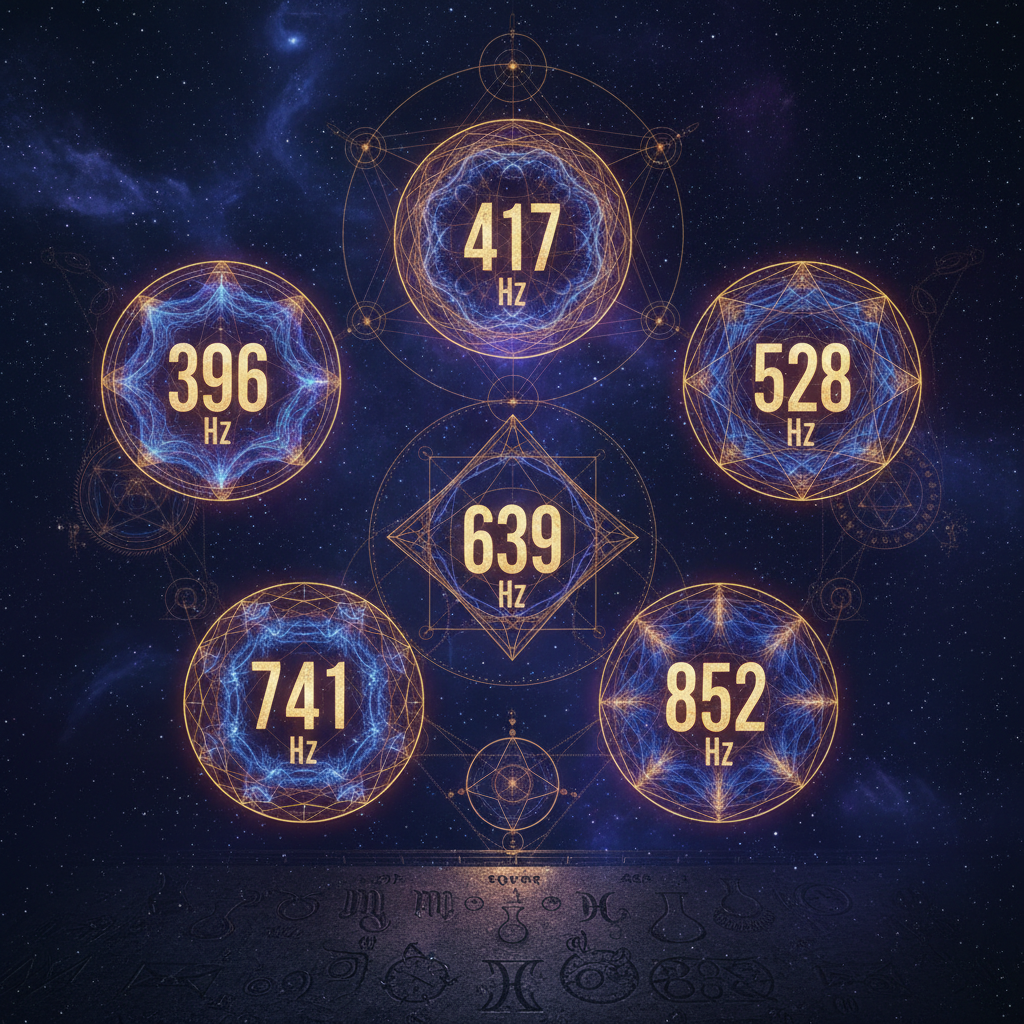
The Nine Tones and Their Traditional Purpose
Each tone has been assigned a domain in the modern Solfeggio system. These associations are not arbitrary — they correspond to the chakra map of the body and to a felt-quality that experienced sound workers report converging on independently.
174 Hz — Foundation. A grounding, almost-subsonic tone reportedly used as a 'natural anaesthetic' for physical pain and to signal safety to the nervous system. A good opener for any session.
285 Hz — Tissue Repair. Associated with cellular regeneration and structural integrity. Often used after physical injury or surgical recovery.
396 Hz — Liberation from Fear. Root-chakra tone. Said to dissolve subconscious blocks and the felt-sense of guilt.
417 Hz — Facilitating Change. Sacral tone. Used to clear traumatic imprints and open stagnant emotional patterns.
528 Hz — Transformation / DNA Repair. The 'Miracle Tone' — by far the most studied of the nine. Solar-plexus / heart bridge.
639 Hz — Connection. Heart tone. Used in relationship work, reconciliation, and group coherence practices.
741 Hz — Awakening Intuition. Throat tone. Clearing of expression and access to inner knowing.
852 Hz — Spiritual Order. Third-eye tone. Direct perception, returning the field to alignment.
963 Hz — Unity / Crown Opening. The highest of the nine. Associated with the felt-sense of oneness and source-connection.
A simple ascending sequence — 3 to 5 minutes per tone, from 174 Hz up to 963 Hz — takes roughly 30 minutes and produces what most practitioners describe as a complete 'tuning' of the energetic system.
Why Layered Drone Matters
A bare sine tone at, say, 528 Hz, is psycho-acoustically thin. The ear hears it as electronic, sterile, and easy to mentally tune out. Real-world sacred-sound instruments — Tibetan bowls, didgeridoo, gongs, the human voice — are never pure tones. They produce a rich harmonic stack: the fundamental plus the octave below, the fifth above, and a shifting cloud of overtones that gives the sound its body.
The Solfeggio Portal in this archive synthesises a comparable stack. The fundamental tone is reinforced by a sine partial an octave below (giving body and a felt-sense in the chest), a just-fifth above (giving harmonic openness), and a slow detune LFO (giving the organic shimmer of a hand-struck instrument rather than the lifelessness of a fixed oscillator).
The practical effect: the tone becomes something the body wants to settle into, rather than something the mind has to tolerate. Sessions become longer and easier. Most users report being able to sit with a Solfeggio frequency for 20+ minutes only once the drone is added — without it, attention drifts within five.
Stacking Binaural Entrainment on Top
Solfeggio tones and binaural beats are not the same thing, but they combine well. A Solfeggio tone is an absolute carrier frequency — what the ear hears. A binaural beat is a *difference* between two carrier frequencies, perceived by the brain as a third tone at the difference, which then entrains the dominant brainwave in that range.
When the Portal's binaural offset is enabled, the right ear receives the Solfeggio tone plus a small offset (1–20 Hz). The brain perceives the difference as a phantom tone in the entrainment range:
- 2–4 Hz offset → Delta — deep restorative states, healing. - 4–8 Hz offset → Theta — meditation, hypnagogia, psi-receptive states. - 8–14 Hz offset → Alpha — relaxed awareness, creative flow. - 14–20 Hz offset → Beta — focused, alert, working states.
A common protocol is to layer 528 Hz with a 6 Hz theta offset for meditative work, or 963 Hz with an 8 Hz alpha offset for opening practices. Stereo headphones are required — a single ear or mono speaker collapses the binaural illusion. The Solfeggio frequency provides the vibrational 'colour' of the session; the binaural offset shapes the brain state.
A 30-Day Practical Protocol
If you want to test the system honestly on yourself, run the following for thirty days and keep a brief journal. The cumulative effect is what most practitioners report as transformative; isolated sessions are merely interesting.
Daily core (15 minutes). Sit or lie comfortably. Headphones on. Choose a single tone for the day — most people benefit from staying with 528 Hz for the first week to establish a baseline. Drone on. Binaural offset off for week one, then on at 6 Hz from week two onwards. Eyes closed. Attention on the breath. Do nothing with the tone — let it work on you.
Weekly full-spectrum session (45 minutes). Once per week, run the full ascending sequence — 174 → 285 → 396 → 417 → 528 → 639 → 741 → 852 → 963 Hz, five minutes each. This is the equivalent of a chakra-tuning session and the deepest single practice in the system.
What to track. Sleep quality, baseline anxiety, the quality of attention on waking, and any unsolicited dreams or intuitions. Most users report distinct shifts within ten days; near-universal shifts by day thirty. If you notice nothing after a careful month, the system is not for you — and you will have a personal data-set rather than an opinion.